What is epoxy terrazzo flooring?
Epoxy terrazzo flooring is a thin-set terrazzo in which epoxy resin, not cement, binds the aggregate. The mix is poured in place over a prepared concrete slab, left to cure, then ground flat and polished until the aggregate shows as a smooth, even surface.
Read more
How the system is built up
- Prepared substrate. A sound concrete slab or screed, opened by shot blasting or grinding.
- Primer. An epoxy primer that seals the concrete and gives the terrazzo a mechanical and chemical bond.
- Crack-isolation membrane. A flexible layer laid over the slab, or over cracks and joints only, where movement could telegraph through.
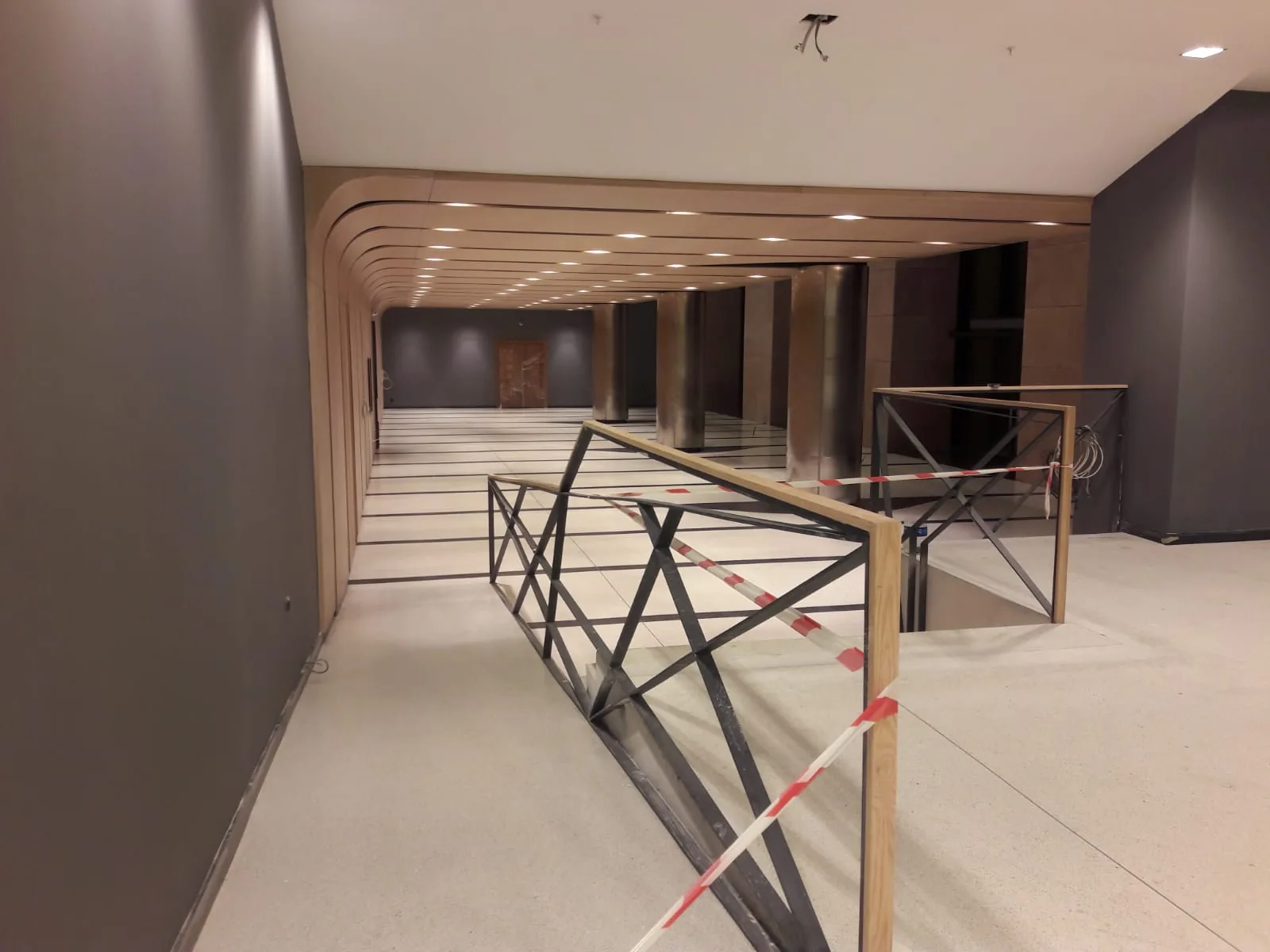
- Divider strips. Brass, aluminium, zinc or plastic strips set out the pattern and separate the colour fields.
- Terrazzo layer. Pigmented epoxy filled with graded aggregate, trowelled to level.
- Grinding, grouting and sealing. Successive grinds expose the aggregate, a grout coat fills pinholes, and a sealer finishes the surface.
Thickness and weight
Epoxy terrazzo is usually laid at around 6 to 10 mm, depending on the aggregate size and the system. That is far thinner than cement-based terrazzo, so it adds little load to a structure and fits where the finished floor level is fixed, as it often is in refurbishments and on upper storeys.
Aggregate and colour
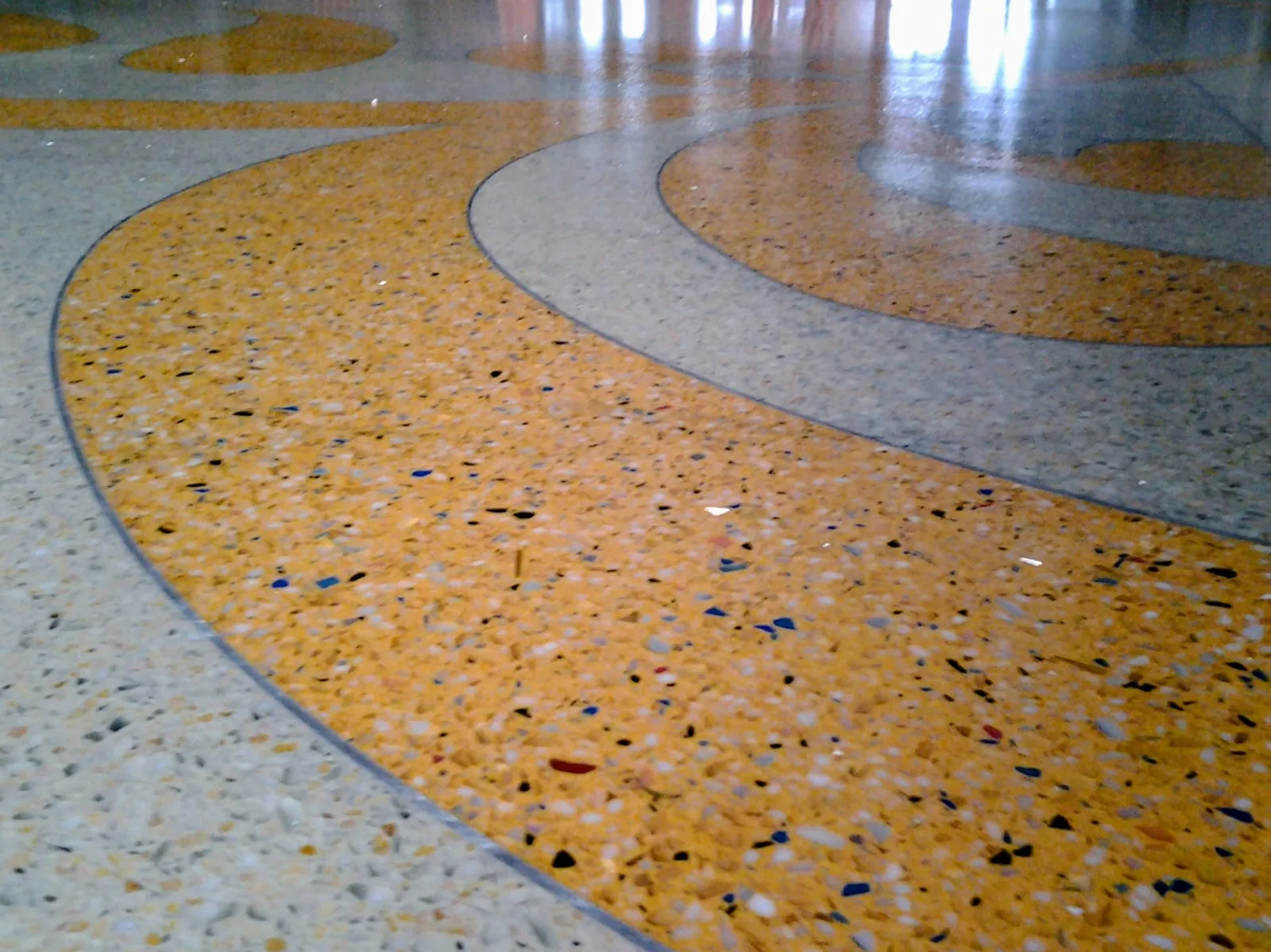
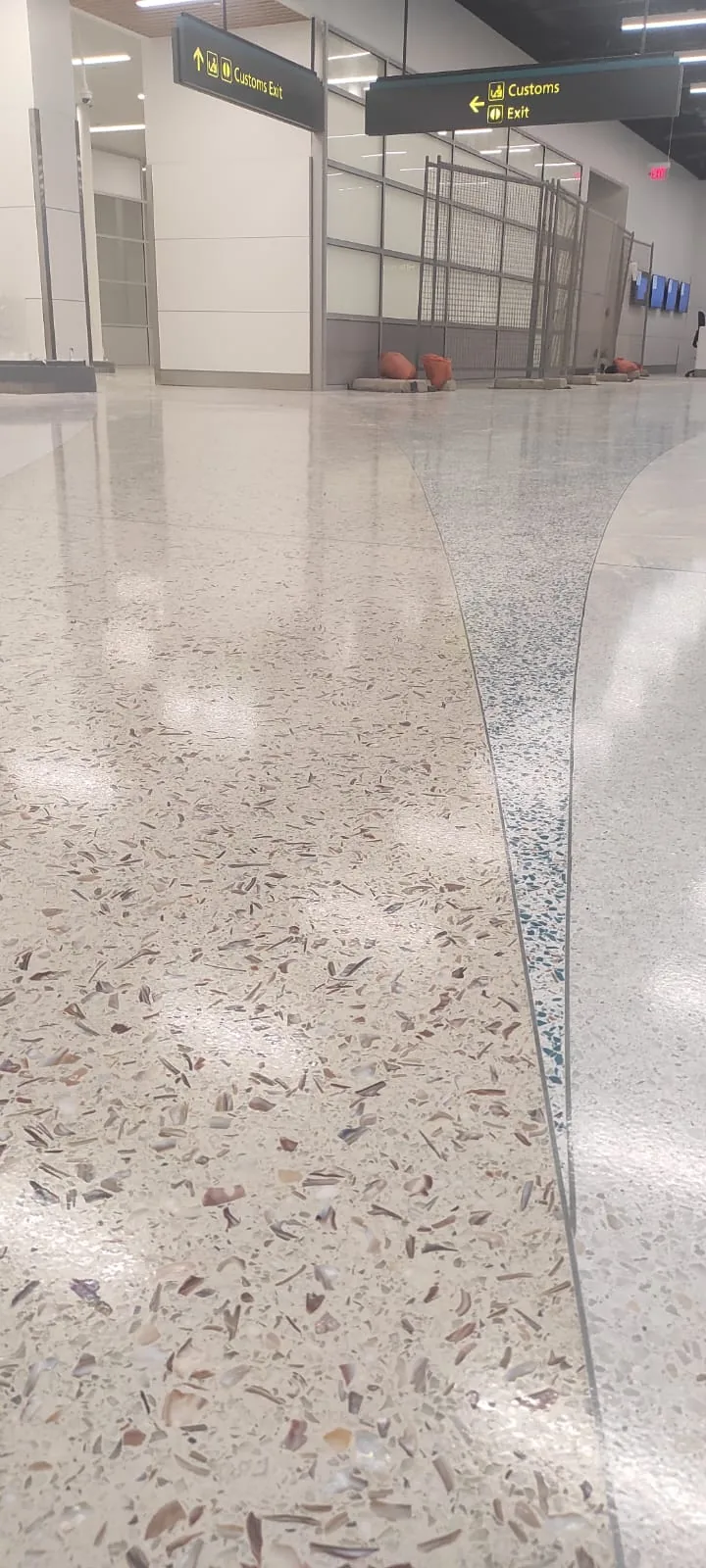
Marble chips are the most common aggregate. Granite, recycled glass, mirror and mother-of-pearl give other effects. The resin can be pigmented to almost any colour, and the pattern can include logos, wayfinding lines and inlays cut to the architect's drawing.
Epoxy terrazzo compared with poured terrazzo and other floors
Traditional poured terrazzo uses cement as the binder and is laid much thicker, often several centimetres. Epoxy terrazzo uses resin, goes down thin, is usually ready for foot traffic within a few days rather than weeks, and can be laid in large panels without the frequent control joints that cement terrazzo needs to avoid cracking.
Read more
Epoxy terrazzo or cement-based poured terrazzo
- Thickness: epoxy is a thin veneer; cement-based poured terrazzo needs a much deeper build and more structural load.
- Colour: epoxy takes bright and saturated colours; cement limits the palette.
- Joints: epoxy allows large seamless fields; cement terrazzo is divided into small panels.
- Curing: epoxy is ready for the next stage within about a day; cement terrazzo needs days of wet curing.
- Exterior use: cement-based terrazzo suits outdoor and sun-exposed areas better, since many epoxies change colour under direct UV light.
Against tiles and stone
Porcelain tiles and natural stone have grout or joint lines every few hundred millimetres. Those lines collect dirt, crack under rolling loads and break up a design. A seamless terrazzo floor avoids them, which is a large part of why terminals, malls and hospitals choose it.
Against industrial resin floors
Where the floor serves production, forklifts or hot washdown rather than the public, a decorative finish is the wrong choice. Polyurethane concrete takes thermal shock and aggressive chemicals that would damage a terrazzo surface. Many projects use both: terrazzo in the public and office areas, PU concrete in the kitchens, plant rooms and loading bays.
Where epoxy terrazzo is used
Epoxy terrazzo flooring suits interiors that carry heavy foot traffic and need a strong design: airport terminals, cruise ports, malls, hotels, hospitals, offices, showrooms, schools and places of worship. It also works in private homes where the owner wants a seamless floor across several rooms.
Read more
Transport buildings
Terminals and ports need floors that keep their appearance under trolleys, rolling luggage and night-time scrubber-driers. We have laid airport terrazzo flooring at Princess Juliana International Airport in Sint Maarten for Ballast Nedam, and terrazzo in the first phase of the Galataport cruise port at Salıpazarı, Istanbul.
Places of worship and public buildings
Large prayer halls and public lobbies benefit from seamless fields and patterns set into the floor. Our work includes Çamlıca Mosque in Istanbul for Güryapı and the Bursa Metropolitan Municipality service building.
Hospitals
A dense, non-porous surface without grout lines is easier to keep clean, which matters in wards and corridors. We have installed terrazzo at Yeditepe University Oncology Hospital and at Memorial Ataşehir and Memorial Şişli hospitals in Istanbul.
Retail and hospitality
Malls and stores use terrazzo to carry brand colours and logos into the floor. Our list includes the Al-Afaf Mall in Karbala, Optimum İzmir, Novada Yozgat, the Nike store in Ankamall, Arçelik stores, and hotels in Antalya and Yalova.
Pharmaceutical plants and automotive showrooms
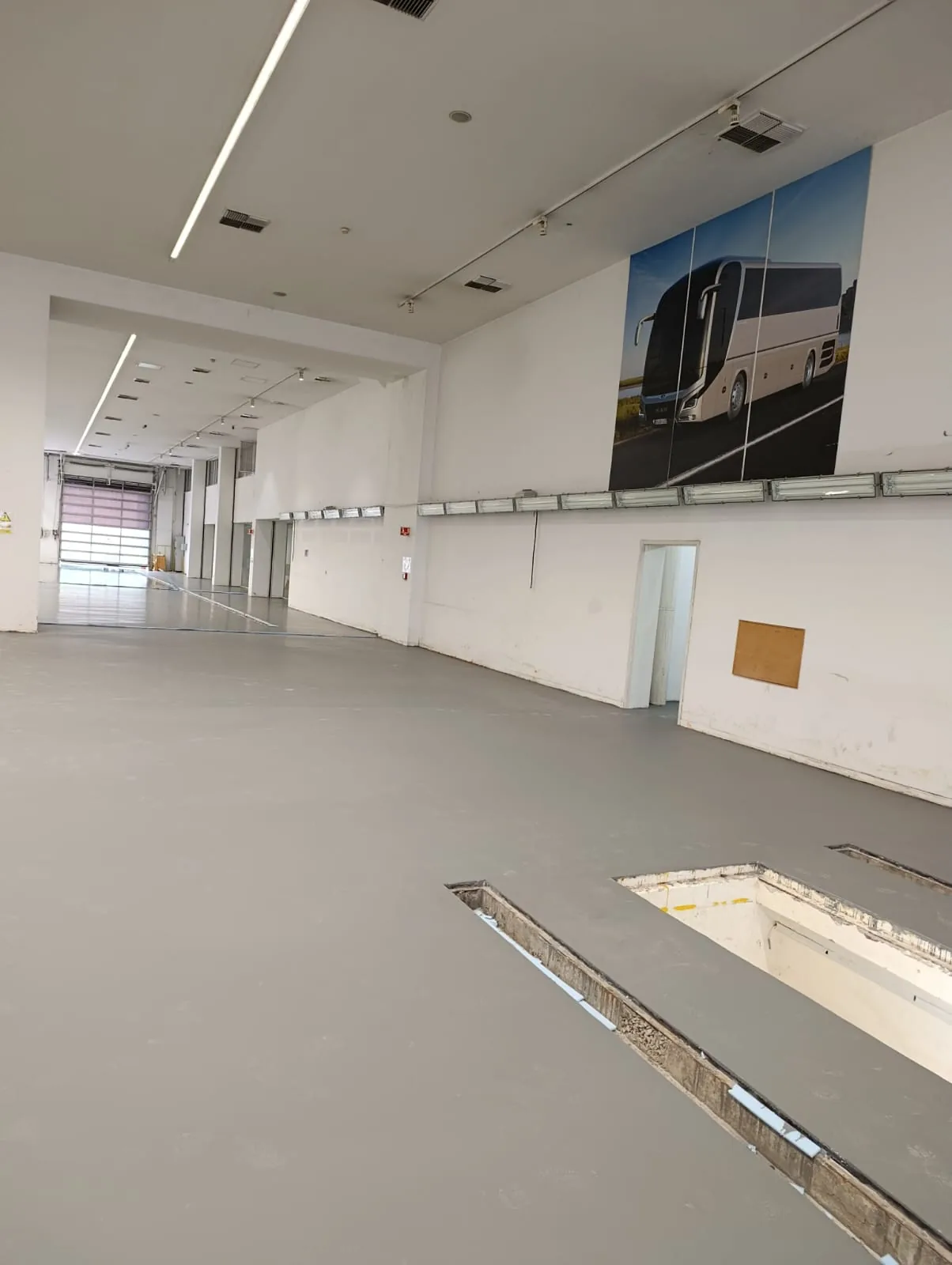
Pharma terrazzo is a separate system from epoxy terrazzo: a granite-look epoxy mortar, listed in our Turkish range as Epoksi granit görünüm (page in Turkish). We have laid it in the customer centre and delivery showroom at MAN Türkiye in Ankara and at the Arven İlaç plant in Kırklareli; these jobs are not counted among our 23 terrazzo projects.
Performance: wear, chemicals, hygiene and slip
Epoxy terrazzo flooring resists abrasion and impact well, does not take up water, and stands up to the cleaning chemicals used in public buildings. Because the surface has no joints and no pores, dust and bacteria have nowhere to collect.
Read more
- Abrasion and impact: the hard aggregate carries the wear, and the resin holds it in place, so the floor keeps its finish under heavy footfall.
- Chemical resistance: good resistance to common cleaning agents, oils and many dilute acids and alkalis; the exact range depends on the resin.
- Water: impermeable, so spills stay on the surface and do not stain the slab.
- Hygiene: no grout lines and no open pores, which suits hospitals and food service areas.
- Dust: the floor does not shed dust, unlike bare or poorly sealed concrete.
- Corrosion: resin and stone do not rust; divider strips are chosen to suit the cleaning regime.
Slip resistance
A polished terrazzo floor is smooth. For entrances, wet areas and ramps, slip resistance is raised with the choice of sealer, a finer final grind, or anti-slip additives in the finishing coat. The target is agreed with the designer, and the floor should be tested where the specification calls for it.
Temperature and light
Epoxy terrazzo is an interior floor. Strong, direct sunlight through glazing can shift the colour of some epoxies over time, so UV-stable resins or finishes should be specified where a floor sits under large glazed areas. Underfloor heating is possible with the right system, and the heating should be run at a low setting during installation.
How an epoxy terrazzo installer lays the floor
Installation runs in a fixed order: survey, preparation, primer, membrane, divider strips, pour, grind, grout, polish and seal. Each stage depends on the one before it, so the area has to stay closed to other trades from preparation to handover.
Read more
- Survey. Slab strength, moisture and flatness are typically checked, and cracks and movement joints are marked. Moisture above the system's limit has to be dealt with before any resin goes down.
- Preparation. The slab is shot blasted or ground to remove laitance and open the surface. Our page on shot blasting floor preparation is in Turkish.
- Repairs and primer. Cracks and hollows are filled, then the primer seals the slab.
- Membrane. Where needed, a crack-isolation membrane is laid across the floor or along cracks and joints.
- Divider strips. The pattern is set out from the drawings and the strips are bonded in place, aligned with the slab's movement joints.
- Pour. Each colour field is mixed, placed and trowelled level to the top of the strips.
- Cure. The resin hardens, usually overnight, depending on temperature.
- Grind and grout. Coarse to fine grinding exposes the aggregate; a grout coat fills pinholes, then further grinding follows.
- Polish and seal. Final polishing and a sealer give the finished sheen and protect the surface.
Room temperature and humidity must stay within the manufacturer's limits throughout. Large jobs are usually split into zones so other trades can continue elsewhere on site.
Terrazzo flooring cost: what sets the price per m²
Terrazzo flooring cost depends on the floor, so we price every project from its drawings and a survey rather than from a list. The biggest variables are the area, the slab condition and the complexity of the design.
Read more
Factors that drive the price
- Area: large open areas spread mobilisation and machine time over more square metres, so the cost per m² falls.
- Substrate condition: a sound, dry, flat slab needs less work than one with cracks, moisture or old coatings to remove.
- Thickness: a thicker layer uses more resin and aggregate and takes longer to grind.
- System: a full crack-isolation membrane, UV-stable resin or anti-slip finish adds material and labour.
- Colour and aggregate: marble is the baseline; glass, mirror and mother-of-pearl cost more, as do many colour fields.
- Pattern: curves, logos and inlays mean more divider strip and more hand work.
- Site conditions: access, working hours, heating or cooling, and work on a live site all affect the programme.
- Timeline: a compressed programme may mean night shifts or more crews.
- Location: for work abroad, travel, accommodation, freight and customs are priced in.
Lifetime cost
The installed price is only part of the picture. A seamless floor that needs no regrouting, no tile replacement and only routine cleaning often costs less over the life of a building than a cheaper floor at handover. Ask for the maintenance guidance for the proposed system alongside the offer so you can compare like with like.
To get a figure, send the area, location, use and photos or drawings through our contact page.
Care, maintenance and service life
Day-to-day care is simple: dry dust mopping or vacuuming, then damp mopping or machine scrubbing with a pH-neutral cleaner. Avoid strong acids, bleach in concentrate and abrasive pads, which can dull the sealer.
Read more
Routine care
- Use entrance matting to stop grit being tracked in, since grit is the main cause of surface wear.
- Clean spills promptly, especially oils, dyes and acidic drinks.
- Use soft or white pads on scrubber-driers.
- Fit felt or soft pads under furniture that is moved often.
Periodic maintenance
Depending on traffic, the sealer may need refreshing from time to time. Heavily trafficked areas such as entrances and concourses show wear first. Because the aggregate runs through the whole terrazzo layer, a worn floor can be reground and resealed to restore its finish, rather than replaced.
Service life
Well-installed epoxy terrazzo flooring is a long-term finish, typically lasting for decades with proper care. It is often chosen precisely because it outlives tiles and carpets in busy public buildings. Renewal is also possible: we renewed the existing terrazzo floor at Nata Vega for Güryapı and Alfa Terrazzo.
The facility team should have written cleaning guidance for the specific sealer and system used, since cleaning chemicals that suit one sealer can dull another.
Our epoxy terrazzo flooring projects
Our terrazzo reference list holds 23 projects with a combined area of 73,885 m², in Türkiye, Iraq and Sint Maarten. Most were carried out for main contractors, including Ballast Nedam, Al Qalab Cons., Güryapı, Elips Yapı Kimyasalları and Şekerci İnşaat.
Read more
Abroad
- Princess Juliana International Airport, Sint Maarten, for Ballast Nedam
- Al-Afaf Mall, Karbala, Iraq, for Al Qalab Cons.
In Türkiye
- Çamlıca Mosque, Istanbul, for Güryapı, and phase 1 of the Galataport Salıpazarı cruise port
- Yeditepe University Oncology Hospital, Memorial Ataşehir and Memorial Şişli hospitals
- Bursa Metropolitan Municipality service building, for Elips Yapı Kimyasalları
- Optimum İzmir mall for Ars Dizayn, Novada Yozgat, and Nike in Ankamall for Güryapı
- White Tuana Thermal Hotel in Yalova, Trendy Lara Hotel in Antalya, and the Hilton Altunizade Fami Cafe
- Head offices of Stenkim and Ora İnşaat, Arçelik stores in İzmir and Istanbul, and Kahve Dünyası Veliefendi
- Homes at Bilkent Kalyon and Çayyolu for Şekerci İnşaat
- Galatasaray Island, Istanbul, for Şekerci İnşaat
On large floors such as these, colour consistency across many pours depends on batching resin, pigment and aggregate from the same production lots and mixing every batch to the same ratio. Divider strips also double as construction joints, so each day's pour can stop cleanly at a strip without a visible seam in the colour field.
Master Builders Solutions lists 2EP Zemin as an applicator dealer. Details of these jobs are on our projects page.
Request an epoxy terrazzo quote
Tell us how large the floor is, where the site is and what the space is for, and attach photos or drawings of the slab. We will reply with a proposed system and an offer. Email info@2epyapi.com, call +90 312 276 13 76, or use the contact details on our English home page.
Read more
- Area and number of levels, with plans
- Country, city and target start date
- Type of building and expected traffic
- Slab age, finish and any known cracks or moisture issues
- Colours, aggregate, pattern and any reference images from the design
If the project is at tender stage, tell us the tender date and which documents you can share. We can price from drawings and a written slab description, then confirm the offer after a site survey or a review of site photos.
Once we have the details, we review the slab information, ask any questions about moisture, cracks or levels, and set out the build-up options, with layers and thickness, for you to review. For decorative work, colours and aggregate are usually agreed against approval samples before material is ordered.
At specification stage, the manufacturer's technical data sheets for the proposed system are the documents to check against the written specification.