What is polyurethane concrete flooring?
Polyurethane concrete flooring is a three-component system: a polyurethane resin, a hardener and a cement-based powder filled with graded aggregate. Mixed on site, it cures into a dense floor that behaves much like concrete under temperature changes, so it stays bonded where other resins would shear off.
Read more
How the system is built up
- Prepared substrate. Concrete shot blasted or ground to a clean, open surface, with anchor grooves cut at edges, drains and joints so the floor cannot lift at its free edges.
- Primer or scratch coat. Seals the concrete and gives the main layer a firm key.
- Main layer. Trowelled as a heavy-duty screed or poured as a self-levelling layer, depending on the use.
- Finish. Left smooth for dry areas, or broadcast with aggregate and sealed with a topcoat for slip resistance in wet areas.
- Coving. Where hygiene demands it, the floor turns up the wall in a seamless cove so dirt cannot collect in the corner.
Typical thickness
Thickness depends on the product and the duty. As a general range, flowable self-levelling grades typically go down at about 4 to 6 mm, while trowelled heavy-duty grades are laid at around 6 to 9 mm, and thicker where the floor takes very hot water or heavy impact. Thicker builds generally tolerate a wider temperature range.
Water-based and solvent-free
Many polyurethane cement systems are water-based and solvent-free, with little odour during installation. That matters when a food plant or a building next door stays in use while the floor goes down.
PU concrete, polyurethane cement flooring and epoxy compared
PU concrete, polyurethane cement flooring and urethane cement are names for the same family of floors. They differ from epoxy in one important way: their thermal behaviour is close to that of concrete, so they handle sudden temperature changes, hot spills and steam cleaning that would crack or debond an epoxy floor.
Read more
Against epoxy floors
- Thermal shock: PU concrete takes boiling water, steam and cold-store temperatures; most epoxies soften or crack under them.
- Moisture in the slab: PU cement tolerates more residual moisture than most epoxies, and some systems can go down on concrete as young as seven days.
- Chemicals: PU concrete resists a wider range of organic acids, fats and sugars found in food processing.
- Finish and colour: epoxy gives a glossier finish and more colour choice; PU concrete is matt and offered in a limited palette.
- Cost: epoxy is usually cheaper per m² for light-duty areas where thermal shock is not a factor.
Against decorative floors
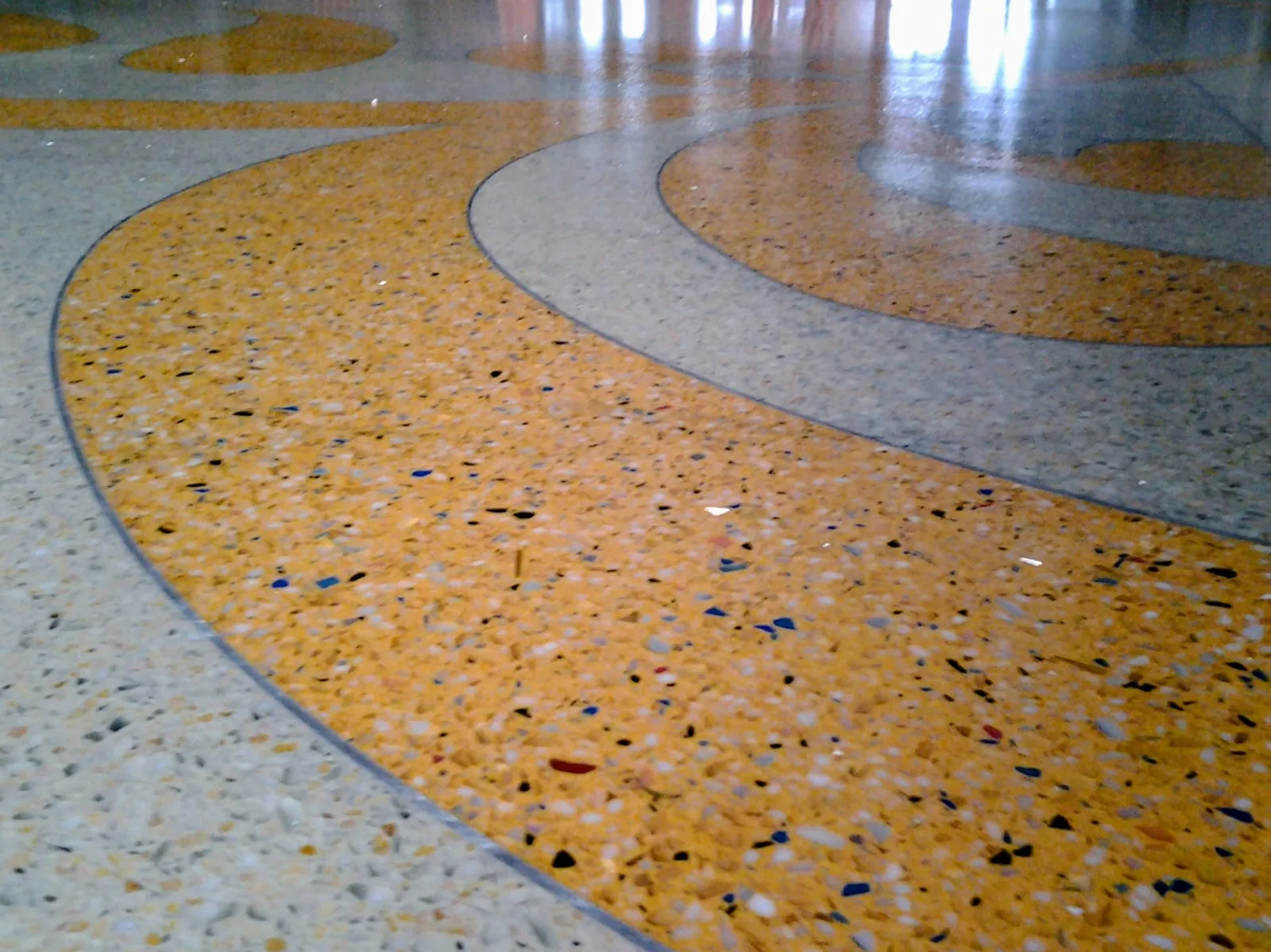
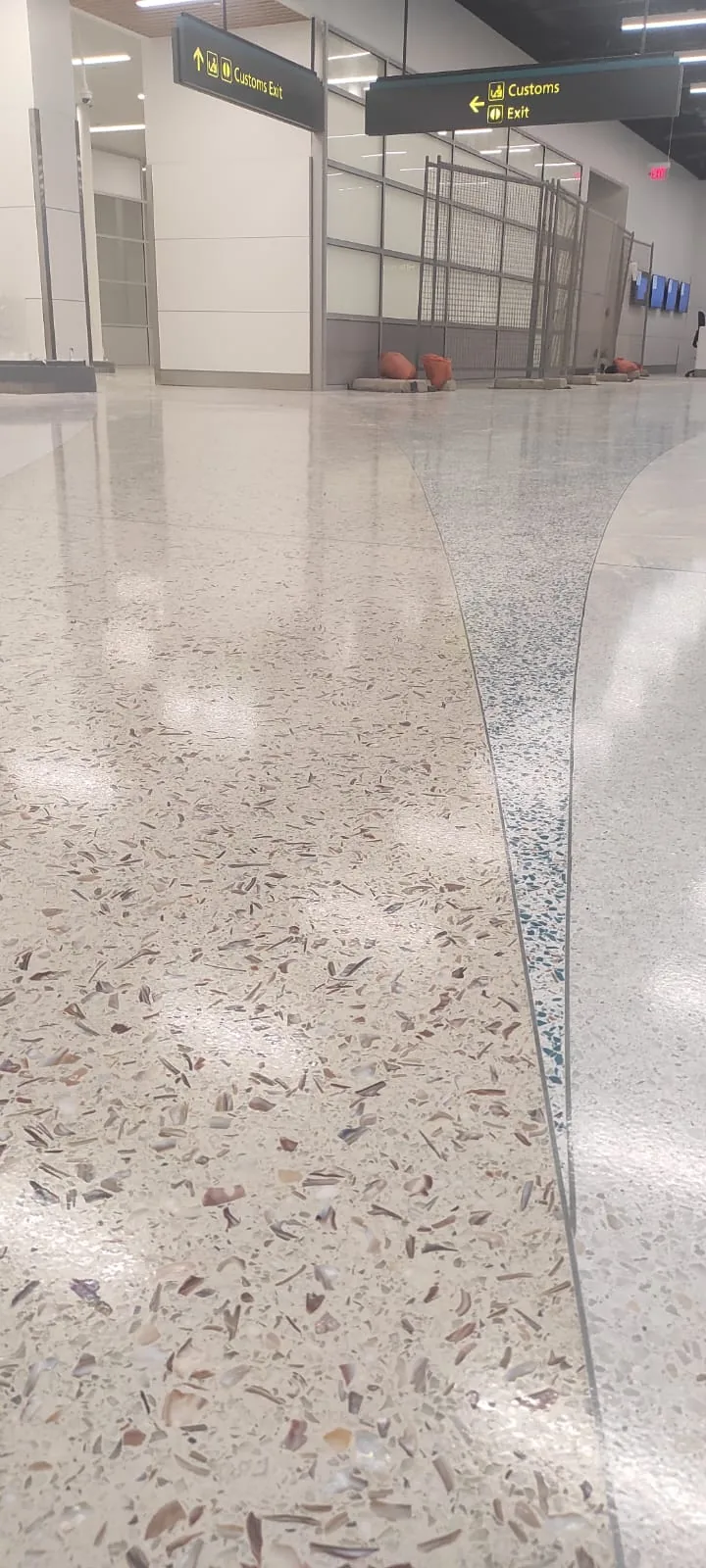
In public and office areas the floor is part of the design, and epoxy terrazzo is the stronger choice. Many buildings combine the two: terrazzo in lobbies, corridors and front-of-house, PU concrete in kitchens, plant rooms, production and loading areas.
How to choose
Start with the conditions on the floor: the heaviest load, the hottest and coldest temperature, the chemicals and the cleaning method. If any of these exceed what epoxy can take, specify polyurethane concrete flooring. If they do not, and appearance or cost matter more, a self-levelling or multi layer epoxy may be enough.
Where PU concrete is used
PU concrete is used wherever a floor faces heavy traffic together with heat, water or chemicals. Typical areas are food and beverage production, commercial kitchens, cold stores and freezers, dairies, breweries, chemical and pharmaceutical plants, laboratories, workshops and heavy production halls.
Read more
Food and beverage
Floors in food plants are washed down daily, often with hot water and steam, and take spills of fats, sugars, milk, blood and fruit acids. A seamless, impermeable PU cement floor with coved upstands gives bacteria nowhere to settle and survives the cleaning regime.
Cold stores and freezers
Thicker PU concrete builds handle sub-zero service temperatures and the thermal shock of doors opening and trucks entering, where most resin floors would crack.
Chemical, pharmaceutical and laboratory
Chemical resistance protects the slab underneath from corrosive spills, and the dense surface is easy to keep clean to the standards of a regulated production area.
Production, automotive and defence
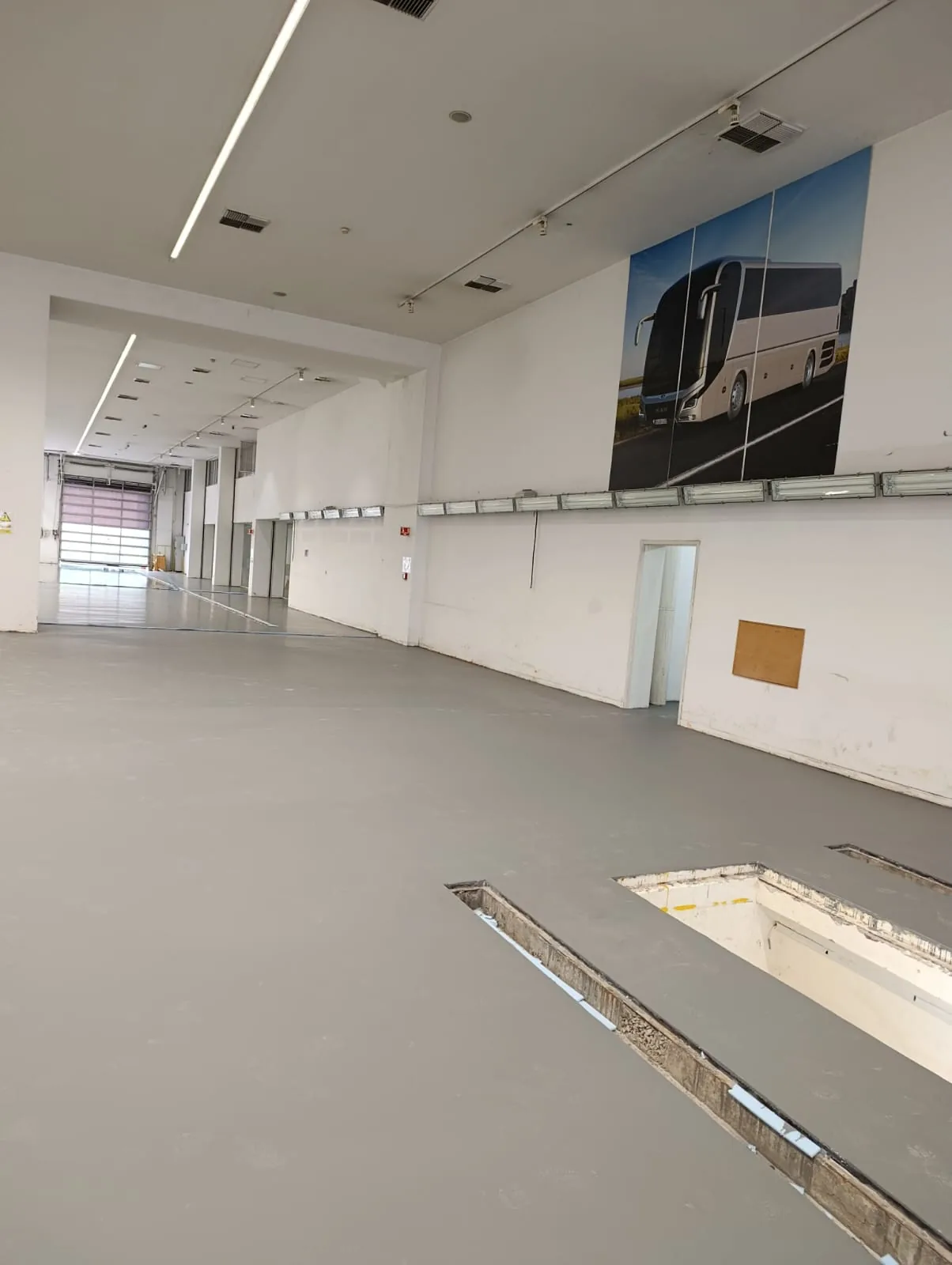
Forklifts, pallet trucks and dropped parts damage softer floors quickly. Our references include the CKD building at Türk Traktör in Ankara and a floor for Balaban İnşaat at the DHMİ (General Directorate of State Airports Authority) in Ankara, and we have laid polyurethane concrete for Aselsan and MAN Türkiye. In our experience, defence-industry projects in Türkiye mostly specify PU concrete and antistatic epoxy.
Projects abroad
For Dalotürk İnşaat we laid polyurethane concrete flooring at Süleymaniye–Kirkuk, Iraq.
Performance: heat, chemicals, wear and hygiene
The main strengths of polyurethane concrete flooring are its resistance to thermal shock, chemicals and abrasion, combined with a seamless, impermeable surface. These properties hold together, which is why the system is chosen for floors that face several hazards at once.
Read more
- Thermal shock: coefficient of expansion close to concrete, so the floor stays bonded through sudden heating and cooling.
- Service temperature: depending on product and thickness, typically from freezer temperatures up to hot washdown, with the thickest builds rated for the highest temperatures.
- Chemical resistance: high resistance to many acids, alkalis, solvents, oils and fats.
- Abrasion and impact: hard aggregate in a tough resin matrix takes forklift traffic and dropped loads.
- Slip resistance: the surface texture can be set to the use, from smooth for dry areas to coarse for wet, greasy floors.
- Hygiene: seamless and non-porous, does not support bacterial growth, and suits steam and pressurised hot-water cleaning.
- Fast return to service: cures quickly, so areas can reopen sooner than with many alternatives.
What it does not do
PU concrete is a functional floor. Its colour range is limited and it can yellow or change shade under UV light, which matters little in a production hall but rules it out as a decorative finish. Colour consistency between batches is also less precise than with epoxy, so large areas are laid in planned bays.
Exact figures for temperature range, chemical resistance and compressive strength come from the product data sheet for the system specified, and should be checked against the duty of each area.
Antistatic epoxy flooring for defence and electronics
Antistatic epoxy flooring carries static charge from people, trolleys and equipment safely to earth, so it cannot build up and discharge into sensitive electronics or ignite flammable vapour. In our experience it is, alongside PU concrete, the floor that defence-industry projects in Türkiye ask for most.
Read more
How it works
The system is a two-component, self-levelling epoxy made conductive with carbon fibres or similar fillers. Beneath it, a primer, copper busbars and a conductive intermediate layer connect the floor to the building's earthing points. Static charge flows through the coating into the busbars and away to earth.
Where it is used
- Electronics production, assembly and storage
- Printed-circuit plants and clean rooms
- Explosives and munitions production and storage
- Fuel stores and areas where flammable gases are handled or filled
- Data and server rooms
Conductive or dissipative
Antistatic floors come in grades with different electrical resistance. Conductive grades are generally used where explosives or flammable atmospheres are present; static-dissipative grades suit most electronics work. The required range comes from the client's specification and the relevant ESD standard, and the floor should be tested against it after installation.
Our work
We have laid antistatic epoxy at Aselsan Macunköy in Ankara for Sun İnşaat, and chemical-resistant self-levelling epoxy in the printed-circuit area at Aselsan Macunköy. More detail is on our Turkish page on antistatic epoxy flooring.
How a PU concrete floor is installed
Installation generally follows this order: survey, preparation, anchor grooves, primer, main layer, finish and coving. Preparation decides how the floor performs, and most early failures of PU concrete trace back to it.
Read more
- Survey. Slab strength, moisture, falls to drains and existing joints are typically checked, and the duty is agreed: loads, temperatures, chemicals and cleaning.
- Preparation. The slab is shot blasted or ground to remove laitance, contamination and old coatings. Our page on shot blasting floor preparation is in Turkish.
- Anchor grooves. Grooves are cut along edges, around drains and at day joints so the floor is locked into the slab at every free edge.
- Repairs and primer. Cracks, holes and joints are treated, then the primer or scratch coat is applied.
- Main layer. The three components are mixed in measured batches and trowelled or poured to the specified thickness.
- Finish. For wet areas, aggregate is broadcast into the surface and sealed with a topcoat.
- Coving and drains. Coves are formed at walls and plinths, and the floor is detailed into drains and channels.
- Cure and handover. The floor takes foot traffic quickly and vehicle traffic after a short cure, depending on temperature and product.
In plants that cannot stop, the work is usually phased by zone or timed to shutdown windows agreed with the client, with day joints placed where the floor layout allows.
What drives the price of polyurethane cement flooring
The price of polyurethane cement flooring per m² depends on the duty the floor must meet and the condition of the slab. We quote each project from a survey or detailed photos and drawings, not from a price list.
Read more
- Area: larger areas spread mobilisation and set-up costs, so the cost per m² falls.
- Substrate condition: old coatings, oil contamination, cracks and weak concrete add preparation and repair work.
- Thickness: the build rises with temperature and impact demands, and so does the material cost.
- System and finish: self-levelling, trowelled or textured, with or without a topcoat.
- Detailing: coves, upstands, drains, channels and movement joints all add linear work.
- Colour: standard colours cost less than special shades.
- Site conditions: a working plant, shutdown windows, night or weekend shifts and climate control affect the programme.
- Timeline and location: a short programme may need more crews; work abroad adds travel, freight and customs.
Lifetime cost
In food and chemical plants, a floor that fails means a shutdown, lost production and repeat preparation. A PU concrete floor that matches the real duty usually costs more to install than epoxy but avoids those repairs. Ask us to compare both systems for your floor and we will set out where each fits.
Care, maintenance and service life
PU concrete is cleaned with the methods food and industrial plants already use: scrubber-driers, pressurised hot water and steam, with detergents suited to the soil. The seamless surface leaves no joints for dirt to collect in.
Read more
Routine care
- Remove spills of aggressive chemicals promptly, even on a resistant floor.
- Choose the cleaning chemical and brush to suit the surface texture, so textured floors stay slip resistant.
- Keep drains and channels clear so water does not stand on the floor.
- Inspect coves, drain edges and joints, where wear and impact show first.
Repairs
Local damage, such as a gouge from a dropped part, can be cut out and patched with the same system. Because the floor is anchored at every edge, a repair does not lift the surrounding area.
Service life
A polyurethane concrete floor sized to its duty and laid on a properly prepared slab is a long-term floor. Service life depends on traffic, chemicals, temperature and cleaning, and on matching the thickness to them. A topcoat on textured floors may need renewing in the most heavily used areas over time.
The facility team should keep written cleaning and inspection guidance for the system and finish installed, and record repairs so wear patterns show up over time.
Our polyurethane concrete flooring work and how to get a quote
Our PU concrete references include Süleymaniye–Kirkuk, Iraq, for Dalotürk İnşaat, the Türk Traktör CKD building in Ankara and the DHMİ floor in Ankara for Balaban İnşaat. More jobs are on our projects page.
Read more
What to send for a quote
- Floor area, location and target start date
- Use of the space and the heaviest traffic: foot, pallet truck, forklift
- Highest and lowest temperatures, including washdown water
- Chemicals spilled or used for cleaning
- Slab age and condition, existing coatings, and photos
- Any antistatic or ESD requirement
Send the details to info@2epyapi.com or phone +90 312 276 13 76; our English home page lists the full contact details. We reply with a proposed system and an offer.
If a specification is already written, we align our proposal with it; where the duty is still open, we propose a build-up from the conditions you describe. On defence and other secure sites, tell us the access and security procedures at the start, because they shape the programme and site planning. If the building also has front-of-house areas, we can price epoxy terrazzo for them in the same offer.